
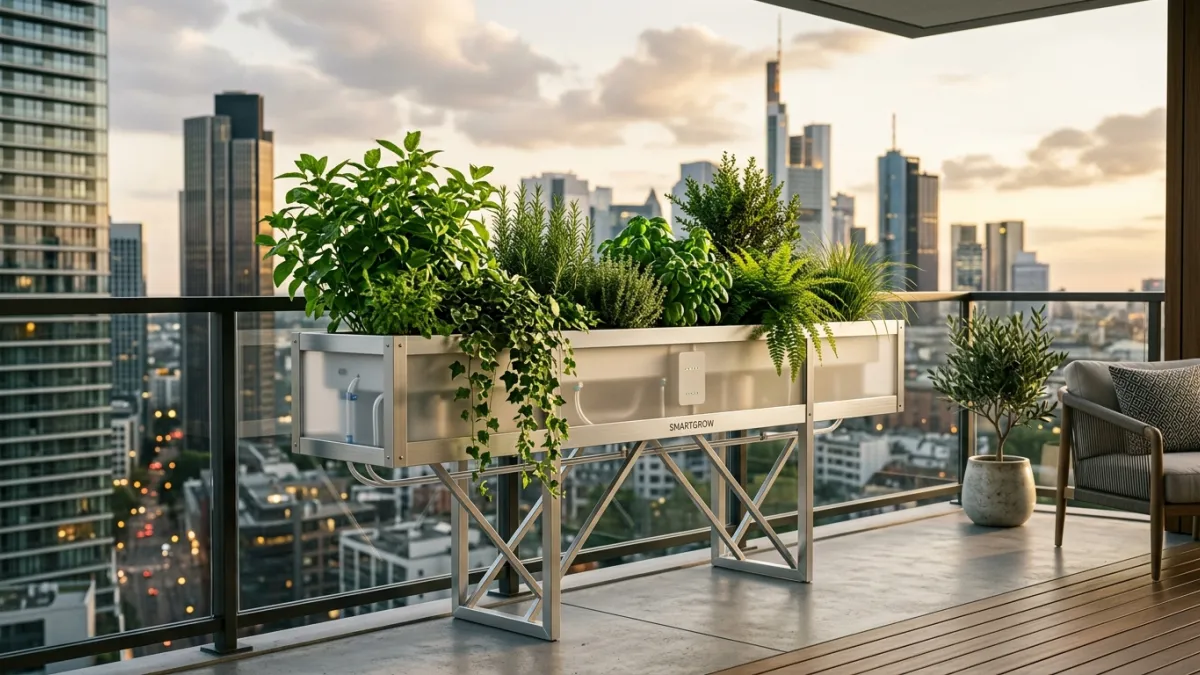
Installing a raised bed on a rented balcony brings fresh herbs and vegetables right to your doorstep, but exceeding structural weight limits poses serious safety and legal risks. Before filling a heavy wooden planter with wet soil, calculating the exact load capacity is crucial to protect your balcony structure and tenancy agreement.
1. Understanding Balcony Load Capacity (Statik)
In Germany and across Europe, structural building standards (such as Eurocode 1 / DIN EN 1991-1-1) set the minimum safety criteria for residential balconies. Generally, modern reinforced concrete balconies engineered after 1980 can support a live load of 400 to 500 kg per square meter (kg/m²). However, historic buildings (Altbau) or lightweight steel and wooden balcony extensions often have significantly lower limits, capped between 200 and 300 kg/m².
Live load includes everything non-permanent: human occupants, outdoor furniture, accumulated snow, and garden containers. To maintain a safe safety margin, structural experts recommend keeping permanent garden containers below 50% to 60% of your balcony's maximum structural capacity.
2. How to Calculate Total Planter Weight
A common mistake in urban gardening is calculating dry weight. Saturated potting soil weighs up to 60% more than dry soil after heavy rainfall. Use this step-by-step formula to compute the realistic maximum weight of your raised bed:
- Determine Volume (Liters): Multiply Length (m) × Width (m) × Soil Depth (m) × 1,000. For example, a box measuring 1.0m × 0.5m × 0.4m equals 0.2 m³, which holds 200 Liters.
- Calculate Wet Substrate Weight: Standard potting soil weighs approximately 0.9 to 1.1 kg per liter when fully saturated. A 200L bed filled with standard garden soil weighs around 200 kg when wet.
- Add Structural Weight: Include the dry weight of the planter box itself (a typical pine timber raised bed adds ~25 kg) plus mature plants and water reserves. Total mass = 225 kg.
- Calculate Surface Pressure: Divide total weight by the footprint area. A 225 kg planter occupying 0.5 m² exerts a localized load of 450 kg/m²—a figure that dangerously approaches the limit of modern balconies and exceeds older ones.
3. Comparing Substrates: Standard vs. Lightweight Fillers
To keep structural loads low while providing adequate root depth, substitute traditional topsoil with engineered lightweight growing mediums like expanded clay (Blähton), perlite, and coconut coir (Kokosfaser).
| Substrate Mixture | Saturated Weight (per 100L) | Drainage Quality | Best Recommended Use |
|---|---|---|---|
4. Step-by-Step Lightweight Raised Bed Assembly
Follow this procedure to set up an ultra-light, balcony-safe raised bed system:
Step 1: Choose Elevated Planter Designs
Opt for table-style raised beds (Tischhochbeet) with legs rather than deep, floor-to-top timber boxes. A soil depth of 20 to 25 cm is sufficient for salad greens, radishes, spinach, herbs, and bush tomatoes, reducing substrate weight by over 50%.
Step 2: Line with Light Geotextile Fleece
Staple porous garden fleece (Pflanzvlies) inside the wooden bed. This contains the soil mix while allowing excess water to drain freely, preventing waterlogging that adds unnecessary water weight.
Step 3: Create a Lightweight Drainage Layer
Spread a 3 to 5 cm layer of expanded clay aggregate across the bottom. Expanded clay is significantly lighter than gravel or lava rock and stores minimal excess water.
Step 4: Fill with an Engineered Soil Recipe
Mix 40% high-quality peat-free potting soil, 40% rehydrated coconut coir, and 20% agricultural perlite. This creates an airy, moisture-retentive substrate that retains structural stability while keeping saturated weight under 45 kg per 100 liters.
Frequently Asked Questions
Where is the safest place to position a raised bed on a balcony?
Position heavy raised beds directly against the load-bearing exterior wall of the building. The structural load capacity is highest near the main structural support beams compared to the outer railing edge.
Do renters need landlord permission for balcony raised beds?
Standard movable plant containers generally do not require formal permission. However, large raised beds that could risk structural overload, damage structural facade rendering, or block emergency escape routes require written landlord approval.